Poland Invokes NATO Article 4 as Russia Escalates Against the Alliance
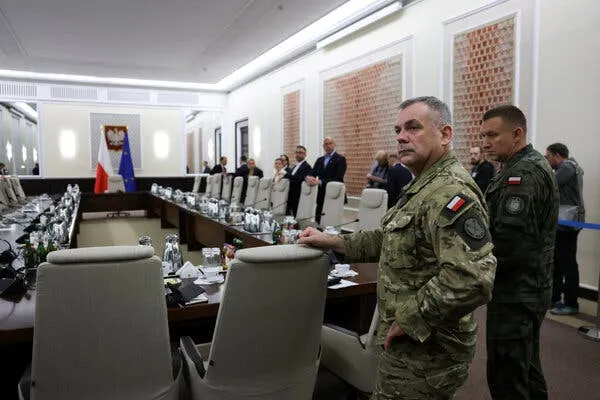
For the first time in years, NATO has been forced to confront Article 4 of its founding treaty after a direct Russian violation of alliance airspace. Overnight, Europe entered a new stage of the conflict as Russia, emboldened by the inaction of the United States, escalated its aggression not only against Ukraine, but against a NATO member, daring the alliance to respond. Polish officials reported nineteen incursions by Russia’s hostile drones into Poland’s airspace, including several crossing from Belarus, deep into alliance territory, forcing the closure of airports and damaging civilian homes. Prime Minister Donald Tusk warned with brutal clarity that the prospect of military conflict in Europe is “closer than at any time since the Second World War.” Poland’s military, with the help of Dutch F-35s, shot down several drones in what leaders described as an unprecedented escalation. Tusk also called it a “large-scale provocation,” and in Brussels, the North Atlantic Council was hastily convened. NATO Secretary-General Mark Rutte described the incursions as “absolutely reckless” and confirmed that allied aircraft had engaged and destroyed threats over NATO skies.
And just hours earlier, an arson attack on two electricity pylons in southeast Berlin had plunged more than 40,000 households and businesses into darkness, cutting power to tens of thousands of residents, shutting down parts of the city’s tram network, and forcing emergency services to set up crisis reporting centers for citizens unable to use telephones. Even after grid operators managed to reconnect half of the affected homes, roughly 20,000 remained without electricity today—a stark reminder that Europe’s civilian infrastructure continues to be deliberately targeted and destabilized. This comes on the heels of reports that Russian drones were reportedly flying surveillance missions over U.S. arms routes in Germany to map which companies are producing weapons for Ukraine and how those shipments move across Europe.
Russia’s brazen attack in Poland came as Russia is set to begin its Zapad 2025 military exercises in Belarus, maneuvers that Moscow has for years exploited as cover to shift troops, weapons, and heavy equipment closer to NATO’s eastern flank, the same maneuvers it used as a staging ground for its 2022 full-scale invasion of Ukraine. The timing was no accident and no coincidence: with Poland running its own exercises and the alliance distracted, the Kremlin seized the opportunity to probe NATO’s defenses, test its resolve, and deterrence posture. These were not stray drones gone off course, nor navigational errors that could be excused away as fog-of-war mishaps. They were a calculated test of NATO itself, an intentional probe designed to measure the alliance’s speed of response, its unity under pressure, and whether it truly has the will to treat an attack on allied territory as the red line it endlessly claims it to be.
Russia pushed ahead with this provocation precisely because it believes escalation can continue unchecked, emboldened by a White House that has shown hesitation at every turn, chaos where clarity is required, and outright fealty to Moscow where resistance should be unflinching, sending another unmistakable message that the world’s most powerful democracy is no longer willing to shoulder the responsibility of leadership.
Donald Trump’s public posture only strengthens that perception. Just days before the incursion, Trump sat beside Poland’s newly elected president, Karol Nawrocki—a man he had openly endorsed during the campaign in a stunning breach of diplomatic neutrality—smiling for the cameras and declaring the U.S.-Polish relationship “better than ever,” promising that American troops would remain in Poland and could even be increased if Warsaw requested it. Yet within days of this performance, European capitals were quietly informed that the Trump regime was pulling back core security guarantees, exposing the staggering hypocrisy of the spectacle. This was not merely an inconsistency but calculated theater, and a deliberate attempt to project strength while in practice leaving allies exposed and providing more cover for Moscow.
Trump has, time and again, demonstrated loyalty to Putin’s regime, and this escalation is the direct and predictable result of that loyalty, as Russia interprets Washington’s silence and the complicity of its president as a green light to intensify its genocidal war in Ukraine and expand it onto NATO soil with no fear of consequence. Last month, Trump literally rolled out the red carpet for Putin in Alaska, staging a meeting that symbolized deference rather than deterrence, after which Russia escalated its genocidal assault on Ukraine to unprecedented levels, leaving me to ask not simply why Trump remains unbothered as provocations mount, but what he promised Putin behind closed doors that has emboldened the Kremlin to push this far, fast, and with this much audacity against the West.
That context makes what followed all the more outrageous. Even as Polish and Dutch jets scrambled to defend NATO skies, Russian state media—through RIA Novosti—ran a feature story boasting that the Pentagon had slashed European readiness fifteenfold, twisting the moment into propaganda that portrayed Western weakness where there had in fact been allied resolve. And in Washington, the images could not have been worse: Trump, Defense Secretary Pete Hegseth, and Secretary of State Marco Rubio dining for several hours at a steak and seafood restaurant while a NATO ally was under direct attack, issuing no statement, offering no reassurance, showing no solidarity, and demonstrating no leadership. The silence was deafening, the optics were so disgraceful, and the message was an unmistakable message to Moscow. Imagine any other American president in modern history behaving so unbothered in the face of a Russian attack on NATO soil.
And as if to underline how quickly the situation is deteriorating, in the weeks since Trump’s Alaska summit, Russia has widened its offensive well beyond Ukraine, hitting EU and British offices inside Ukrainian territory and striking American industrial facilities, making clear that the Kremlin no longer recognizes any boundary between Ukraine and the broader Western footprint. Its hybrid warfare, once deniable and shadowy, has escalated into direct attacks on NATO states themselves, moving from quiet cyber intrusions into acts of outright sabotage against civilian infrastructure, sabotage that has been happening for years but is now becoming bolder, more destructive, and open in its intent.
Most brazenly, Russia recently targeted the top EU leader herself: a GPS jamming assault forced European Commission President Ursula von der Leyen’s plane to land in Bulgaria using paper maps. This timing was no accident and was a deliberate act of aggression carried out as Putin stood in Beijing shoulder to shoulder with Xi Jinping and other authoritarian thugs, a tableau of dictators united in their contempt for the West and intent on breaking its resolve.
As a few of us have warned relentlessly since Russia invaded Ukraine in 2014, this war was never meant to remain inside Ukraine’s borders, because from the very outset the Kremlin’s true objective has been to seize territory in a bloody imperial crusade, to destabilize Europe as a whole, to fracture its democracies, and ultimately shatter the transatlantic alliance—and now that danger has arrived at NATO’s doorstep in plain view.
Putin’s infamous 2016 boast that “there is no end to Russia’s borders” may have sounded like arrogant provocation at the time, but today—with NATO airspace violated, European cities struck, and the European Union’s top leader attacked mid-flight—it reads as a formal declaration of war on the very idea of limits, a stark warning that Russia recognizes no boundary it will not cross or red line it will respect unless it is confronted with overwhelming force.
The West must recognize this escalation as the alarm bell it is. Russia is striking NATO’s borders, targeting European institutions, and attacking civilian infrastructure because it believes the cost is low and retaliation unlikely. Ukraine needs every weapon now to stop Russia’s genocide, which is murdering civilians every single day. Delay is weakness, and weakness only invites more aggression, which as Russia has already shown will not remain contained within Ukraine’s borders but will spread outward.
This is not Poland’s problem alone, nor Europe’s problem alone—it is America’s problem as well. Any American who believes this conflict can be walled off from U.S. interests is deluding themselves. Twice in the last century, the United States learned that European insecurity is American insecurity, and that instability on the continent is a direct threat to U.S. national security. To ignore Russia’s provocations now is to guarantee that the price of confronting them later will be far higher.
Europe must act without hesitation. These drones were a deliberate test of NATO’s resolve. A weak or delayed response will be perceived as an invitation for escalation, and history shows that democracies that flinch in the face of authoritarian aggression ultimately pay a heavy price, often with deadly consequences.