The Costly Trinity: Drugs, Insurance, and Doctors
The reason we pay more for healthcare than everyone else is not a mystery. We pay twice as much for everything, and we have an enormously wasteful private insurance system.
The best place to start in the waste category is prescription drugs. We will spend over $700 billion this year for drugs that would likely cost around $150 billion in a free market. The difference of $550 billion comes to $4,400 per household annually.
This is a case where it really is the fault of the government that drugs are expensive. We grant drug companies patent monopolies. These monopolies allow pharmaceutical companies to sell drugs for thousands or tens of thousands of dollars, when they would likely be available for tens or hundreds of dollars if they sold in a free market without these government-granted monopolies.
The patents monopolies do serve a purpose: they provide an incentive to innovate and develop new drugs. But there are alternatives to granting patent monopolies. We can pay people. The National Institutes of Health and other government agencies used to spend over $50 billion a year on biomedical research.
We can triple this sum and make all findings fully open source so that new drugs can be produced as generics the day they are approved. This would both make drugs cheap and also eliminate most of the motivation for corruption in the pharmaceutical industry.
Drug companies have a huge incentive to lie about the safety and effectiveness of their drugs when they can sell a prescription for $3,000 that costs them $30 to manufacture and distribute. They would have much less incentive to push false stories that jeopardize people’s health if the drug was selling for $50 or $60 per prescription.
Some of us had hopes that RFK Jr., with his complaints about corruption in the pharmaceutical industry, would look to alter the system of patent monopoly financed research, which is the obvious source of this corruption. Instead, he has pushed an incoherent agenda, attacking Tylenol and generally cheap vaccines, that have a proven track record for safety and effectiveness.
Anyhow, when it comes to lowering the cost for drugs we should not expect much from the Trump administration. We might get convoluted rhetoric about lowering prices 700, 800, or even 1,500 percent, but we will not get lower drug prices.
It is also important to note that it is the same story with medical equipment. The thousands of dollars that people might be charged for an MRI or CAT scan is not because the machinery is so expensive to manufacture, or the electricity and technician’s time. It is because patent monopolies allow manufacturers to sell them for hundreds of thousands or even millions of dollars.
Our bloated private insurance system is another source of massive waste in healthcare. We will pay more than $350 billion this year for the administrative costs of private health insurance. This is more than 25 percent of what they pay out to providers. By contrast, the administrative costs of Medicare are just over 1.0 percent of what it pays out to providers.
There are a number of reasons for these differences, but an obvious one is that the insurers pay their top executives tens of millions a year. The top administrators in Medicare get a bit over $200,000 a year. If someone is looking for waste, the excessive pay of insurance company executives is a good place to start. (Where’s Elon’s chainsaw when we need it?)
In addition, the insurers are in business to make a profit for their shareholders, and at least some of them have been doing a good job of that lately. The stock of UH, the parent company of the country’s largest insurer, has doubled over the last five years.
On top of the money directly paid to the insurers, there are also enormous indirect costs. Hospitals, doctors’ offices, and other providers have to spend a huge amount of money hiring staff to deal with the differing rules and forms of various insurers. A recent study found that in 2017, almost a third of our healthcare expenditures went to cover the direct and indirect costs of insurance, almost five times what Canada was spending on a per person basis for its universal Medicare system.
It is also important to recognize that ridiculous prices for drugs and medical equipment create a need for insurers that would not otherwise exist. If a drug company is charging $100,000 for a year’s treatment with a cancer drug, it does make sense to make sure that this drug will actually be more effective than drugs that might cost a tenth or a hundredth as much.
However, if the drug were sold in a free market, and cost a few hundred dollars, there would be little reason to second guess the doctor who originally prescribed the drug. The same story applies to scans or the use of other medical equipment. The scrutiny that insurers impose on many drugs and procedures is largely the result of the high prices charged in the United States.
The last part of the story of bloated healthcare costs is the excessive compensation of doctors. We pay our doctors roughly twice as much as doctors in other wealthy countries. (This is much more a story with specialists than family practitioners.) Getting doctors’ pay down to something close to what they receive in Germany and Canada could save around $100 billion a year.

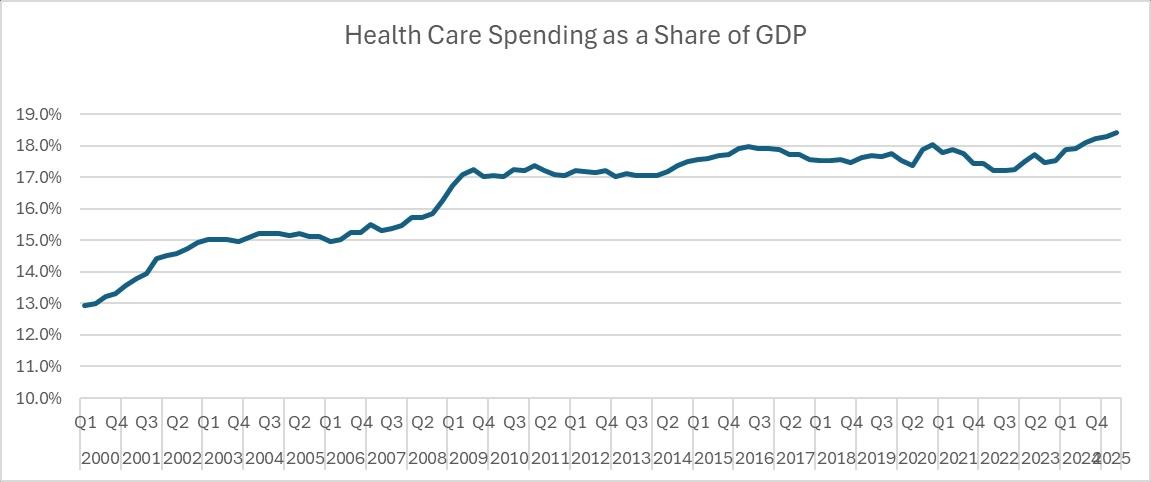 Obamacare was not the only factor in slowing healthcare cost growth, but it surely contributed to it. In any case, there is zero doubt that if healthcare cost growth had increased after 2010, Obamacare would be blamed. Given the reality, Republicans have their directions wrong; Obamacare slowed, not raised, the rate of healthcare cost growth.