The Trump Team’s Purge of Pentagon Photos Raises Sinister Echoes from the Past
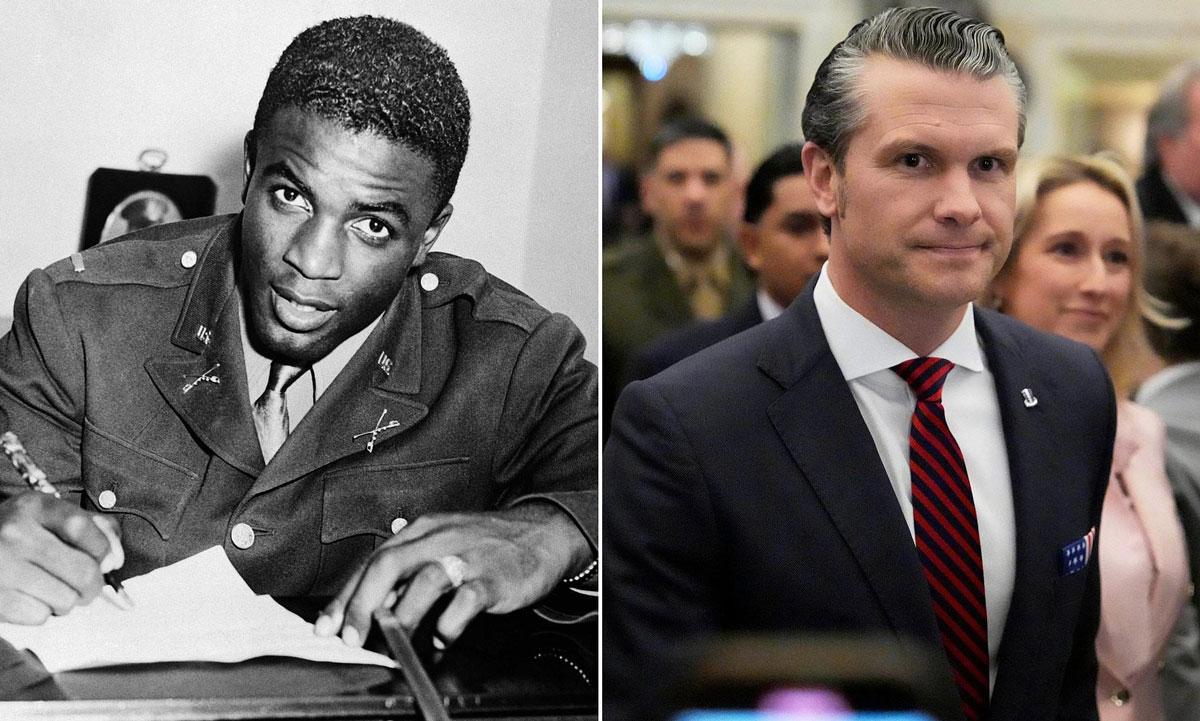
In early June, the Washington Post published a follow-up to earlier stories on a Trump administration plan to remove thousands of photographs from Defense Department websites because of “DEI-related content.” Illustrated with more than a dozen samples of the targeted photos (which the Post‘s reporters were able to find reproduced on non-government websites), the Post‘s new story offered more details on the images marked for deletion because they were deemed to touch on diversity, equity, and inclusion issues — overwhelmingly depicting subjects identified as “gay, transgender, women, Hispanic, and Black.”
The headline over the story didn’t mince words:
“Here are the people Trump doesn’t want to exist.”
Identified from a database obtained by the Associated Press, the targeted subjects included Brooklyn Dodgers baseball star Jackie Robinson, pictured during his Army service before becoming the first Black to reach the major leagues in 1947; the Tuskegee Airmen, who were the nation’s first Black military pilots during World War II; and the Navajo Code Talkers, a Native American Marine Corps unit who used their tribal language on the radio for top-secret communications during the war against Japan. Other banned photos showed women who broke significant gender barriers like Major Lisa Jaster, the first woman to graduate from the Army’s Ranger School, and Colonel Jeannie Leavitt, the Air Force’s first female fighter pilot.
Also deleted were multiple pictures of the Enola Gay, the B-29 bomber (named for the pilot’s mother) that dropped the first atomic bomb on Hiroshima in 1945. That was thanks to an artificial intelligence technique in which computers searched government websites for a list of keywords indicating possibly unacceptable content and inserted “DEI” into the web addresses where any of those words were found, flagging them for removal. For obvious reasons, “gay” was on the banned-word list and, with no human eyes to spot the context, the Enola Gay photos were excised. Some of those photos were fairly quickly reposted, along with other images whose removal had drawn criticism — photographs of the Code Talkers, for example. But thousands of photos were kept offline, making it clear that the basic goal of that purge, the intent to revise history and erase truths and realities that the Trumpists believe challenge their ideology, remains unchanged.
Reading the Post roundup and other articles on the subject reminded me of an event that, while not identical, was similar in meaningful ways to the Trump team’s chainsaw assault on the Pentagon photo archives. It, however, took place in a very different time and setting — nearly 49 years ago, on the other side of the Pacific Ocean. I was then a journalist in Hong Kong, covering stories in China and elsewhere in Asia. Several years into that assignment, in September 1976, China’s longtime Communist ruler, Mao Zedong, died in Beijing. Less than a month later, in early October, his successors arrested his widow, Jiang Qing, and her three principal associates, now condemned as counterrevolutionary criminals for their leading roles in Mao’s catastrophic Cultural Revolution.
Only weeks earlier, hundreds of millions of Chinese and other readers around the world had seen photographs in the Chinese communist newspaper, the People’s Daily, and other official media showing all four sitting in the front row of mourners at Mao’s funeral. After they were arrested, Chinese publications continued to carry those photos — but with Jiang and her three allies, now labeled the “Gang of Four,” airbrushed out. The editing was anything but subtle: blurred smudges or blank spots appeared where they had been in the originals, while their names in the captions were blotted out by vertical rows of X’s.
Though I haven’t found copies of those memorable images, an online search turned up a different set of before-and-after shots without the smudges and blotted-out captions I remember but with equally obvious gaps where each of the four had been standing when the photo was taken.
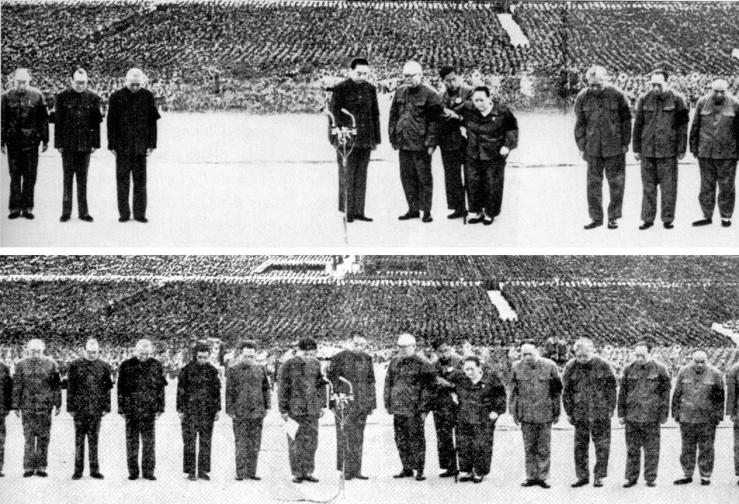
The technology in that now-distant era was different, but the Communist party officials who doctored those photographs were acting in the same way and for the same reasons that motivated Trump’s minions nearly a half-century later, when they eliminated those supposedly DEI-related images and descriptions from the Pentagon archives. Both intended to wipe out any evidence that conflicted with the preferred (and often wildly false) historical narratives propagated by their rulers. Both sought to obliterate visual records that might have raised uncomfortable questions about the political messaging of their leaders and the policies and underlying values they reflected. Both were entirely ready and willing to disregard truth and deny reality in order to protect falsehoods their bosses wanted people to believe.
I have no way of knowing what, if anything, President Trump or Secretary of Defense Pete Hegseth or their censors might know about that earlier example — or anything else about Mao, for that matter, or if any of them have ever even heard of Jiang Qing or the Gang of Four. It’s likely that, like most Americans, they know little or nothing about that now-distant Chinese past. It’s more than likely that they’ve never even heard the name Jiang Qing or the label Gang of Four. Still, the parallels are a chilling reminder that, in democracies as well as in Communist dictatorships, the people in power are often more committed to maintaining that power than to any obligation to tell the truth.