The Spectacle as Opiate and Cover.
The spectacle operates both as distraction and as pedagogy. By dramatizing state violence as entertainment, whether through militarized parades, campaign rallies, or sensationalist media coverage, the Trump regime trains the public to see authoritarian repression as normal, even desirable. The spectacle is a form of civic illiteracy: it numbs historical memory, erodes critical thought, and recodes brutality as patriotism.
The spectacle is more than distraction; it is a smokescreen for systemic violence. Behind the theatrics lie black-site detention centers, the militarization of U.S. cities, and surveillance technologies that monitor everyday life. The media’s complicity, obsessed with immediacy and balance, enables this process by masking the deeper truth: the rise of an authoritarian warfare state at home.
What emerges is not merely a culture of distraction, but the weaponization of spectacle itself. Under Trump, the media’s hunger for shock and drama has transformed authoritarian repression into mass entertainment, flooding the public sphere with images of violence, erasure, and conquest, all while consolidating executive power.
Guy Debord’s notion of the Society of the Spectacle has returned with a vengeance in the abyss of American fascist politics. What the media too often dismiss as “Trump’s diversions” or “stunts” are in fact ritualized performances of state violence, acts of political theater that function as pedagogy. These spectacles do not simply distract—they indoctrinate. They whisper that cruelty is virtue, that repression is order, that vengeance is justice, that fear itself is the normalized rhythm of everyday existence.
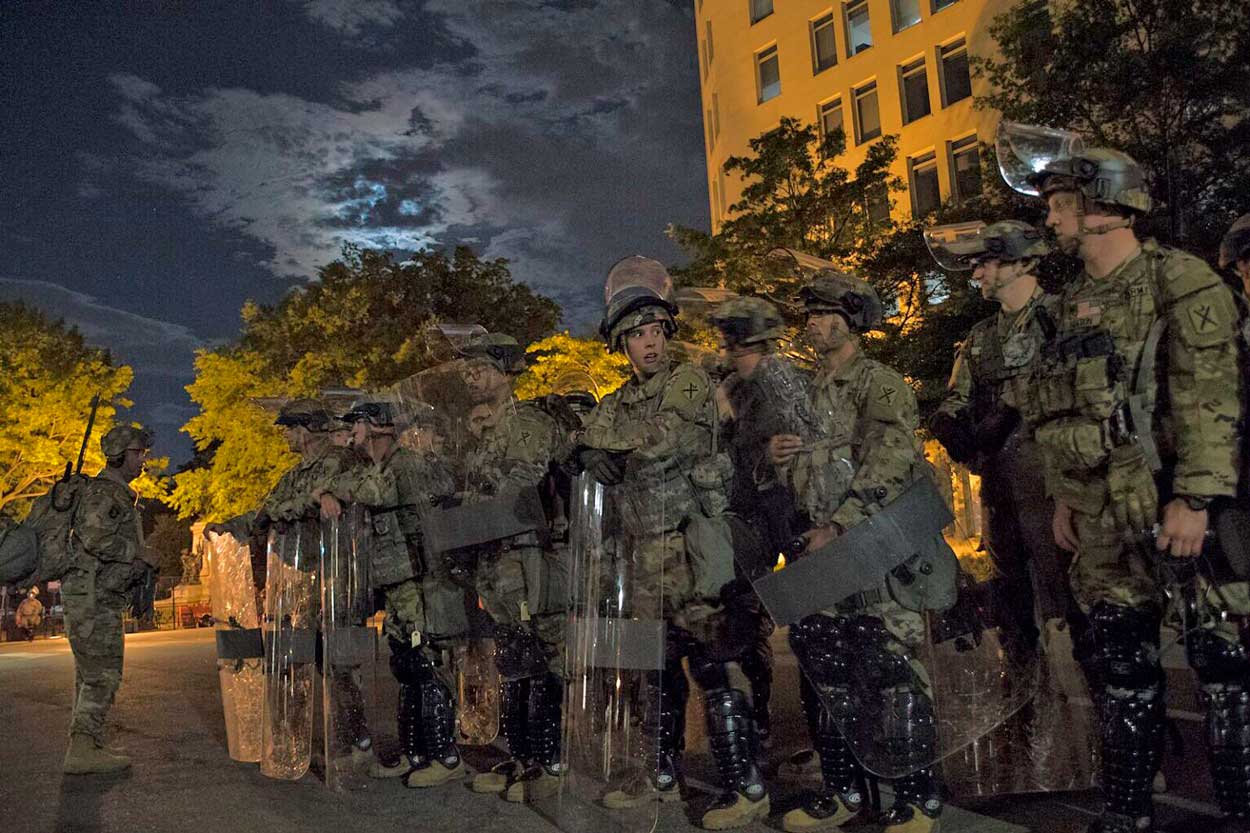
Consider the arming of the National Guard in Washington, D.C., staged as patriotic pageantry rather than as a militarization of civic life. The raid on the home of John Bolton, once a close adviser, later a critic, was choreographed as a national morality play in which betrayal is punished publicly. Trump’s retaliatory campaigns against adversaries like New York Attorney General Letitia James, Adam Schiff, and other so-called “enemies of the state” transform into grotesque spectacles of retribution, political theater driven by an unyielding demand for loyalty. These acts unfold as a public, performative display of power, relentlessly signaling that dissent will not only be silenced but criminalized. The bombing of Iran’s nuclear facilities is framed as a display of strength, not reckless escalation, while ICE raids and masked agents abducting immigrants become national security dramas. These scenes, endlessly replayed across media, merge terror with pedagogy, cruelty with consent, both as performance and an unmistakable threat. But beneath this spectacle lies a deeper truth: a wannabe dictator using state power against, not for, the people and the principles of democracy. Today, state violence targets ICE victims, students, protesters, dissidents, and anyone on Trump’s retribution list—but in the end, no one will be safe from his fascist regime.
This celebration of cruelty and state violence is not limited to highlighting Trump’s political enemies; it extends via a slick promotional ventures used by his political lackeys. For instance, Secretary of the U.S. Department of Homeland Security Kristi Noem, a MAGA-aligned official. shamelessly staged a promotional video against the bleak backdrop of shirtless, caged prisoners in El Salvador’s Terrorism Confinement Center, or CECOT. In her performance, a brutalizing system of incarceration was transfigured into an aesthetic of power and punishment, a stage set for political ambition. Noem’s spectacle reveals how authoritarian pageantry circulates transnationally: the prison state of El Salvador becomes a visual script for U.S. politicians eager to display toughness, exporting the grammar of fascist performance across borders. In this spectacularized culture, politics dissolves into the aesthetics of cruelty, where lawlessness and repression are repackaged as civic virtue and photo ops for what Wilhelm Reich, in Mass Psychology of Fascism, called “the libidinally deranged.”
Here the spectacle does not conceal fascism but embodies it. Each act dramatizes the message that Trump alone decides who is safe, who is punished, who is disposable. Reich’s insight into the fascist “perversion of pleasure” is central: the staging of cruelty is not only meant to terrify; it is meant to gratify. Citizens are invited to experience the humiliation of the weak as a form of release, to find satisfaction in the punishment of the vulnerable. Theodor Adorno’s warnings about the authoritarian personalitycome into sharp relief here: the blending of obedience and enjoyment, submission and aggression, produces subjects who come to desire domination as if it were freedom.
What emerges is an authoritarian economy of desire in which cruelty is transformed into theater. Images of militarized parades, mug shots of political enemies, or caged immigrants circulate across media platforms like advertisements for repression, producing both fear and illicit pleasure. The spectacle trains citizens to consume cruelty as entertainment, to eroticize domination, and to accept vengeance as the highest civic virtue. Watching becomes complicity; complicity becomes a source of satisfaction; satisfaction becomes a form of loyalty.