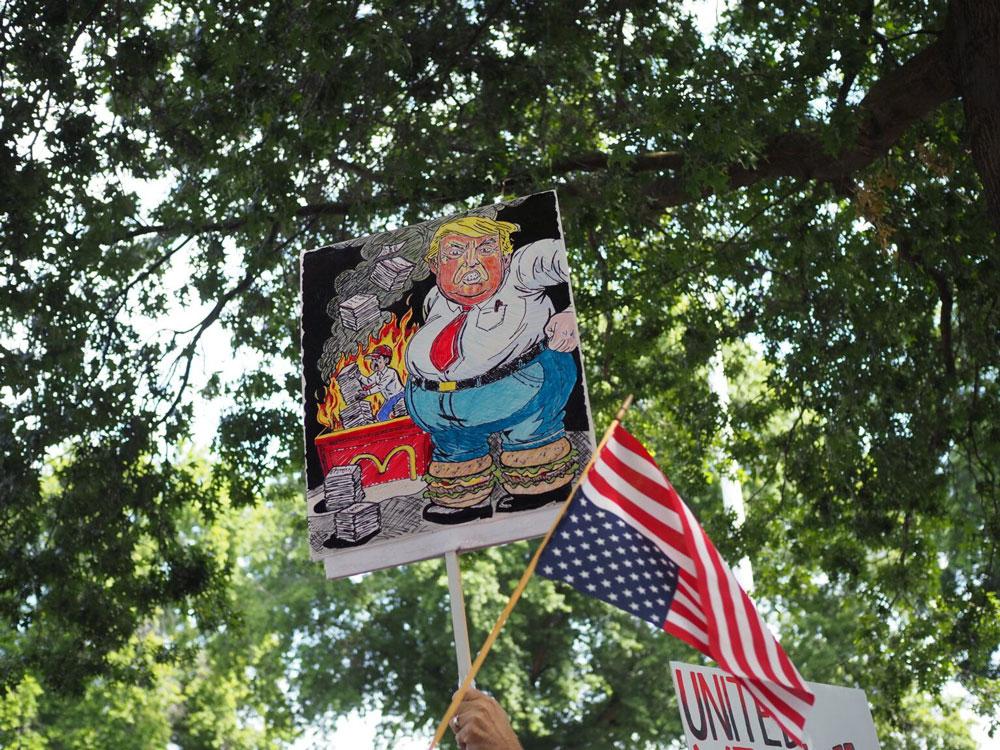
1. Trump’s Impoverishment of U.S. Agriculture.
Trump has created a perfect storm for U.S. agriculture, first in his Cold War policy that has closed off China as a soybean market against and Russia, second in his tariff policy blocking imports and thus raising prices for farm equipment and other inputs, and third in his inflationary budget deficits that are keeping interest rates high for housing and farm mortgage loans and equipment financing – while keeping farmland prices low.
The most notorious example is soybeans, America’s major farm export to China. Trump’s weaponization of U.S. foreign trade treats exports and imports as tools to deprive foreign countries dependent on access to U.S. markets for their exports, and on U.S.-controlled exports of essential commodities such as food and oil (and most recently, high technology for computer chips and equipment). After Mao’s revolution in 1945, the U.S. imposed sanctions on U.S. grain and other food exports to China, hoping to starve out the new Communist government. Canada broke this food blockade – but it has now become an arm of U.S. NATO foreign policy.
Trump’s weaponizing of foreign trade – keeping open a constant U.S. threat to cut off exports on which other countries have come to depend – has led China to totally stop its advance purchases from this year’s U.S. soybean crop. China understandably seeks to avoid being threatened by a food blockade again, and has imposed 34% tariffs on U.S. soybean imports. The result has been a shift in its imports to Brazil, with zero purchases in the United States so far in 2025. This is traumatic for U.S. farmers, because four decades of soybean exports to China have resulted in half of U.S. soybean production normally being exported to China; in North Dakota the proportion is 70%.
China’s shift in its soybean purchases to Brazil is irreversible, as that country’s farmers have adjusted their planting decisions accordingly. As a member of BRICS, especially under President Lula’s leadership, Brazil promises to be much a more reliable supplier than the United States, whose foreign policy has designated China as an existential enemy. There is little chance of China responding to a U.S. promise to restore normal trade by shifting its imports away from Brazil, because that would be traumatic for Brazilian agriculture and would make China an unreliable a trade partner.
So the question is, what is to become of the enormous amount of U.S. farmland that has been devoted to soybean production? Unable to find foreign markets to replace China, farmers are reported to suffer a loss on their soybean production, which is piling up in excess of existing crop storage capacity. The result is a threat of farm foreclosures and bankruptcy, which would lower prices for farmland. And as interest rates remain high for long-term loans such as mortgages, this deters small farmers from acquiring troubled properties. The result is to accelerate the concentration of farmland in the hands of large absentee financial funds and the wealthy.
This shift is irreversible. Despite the Supreme Court ruling that Trump’s tariffs are unconstitutional and therefore illegal, it seems likely that Trump could simply have the bipartisan anti-China Congress and Senate impose these tariffs. In any case, Trump’s policy represents a sea change, a quantum leap into U.S. coercive trade aggression.
There is zero chance of U.S. China trade in soybeans or other basic Chinese needs from being revived. Neither it nor other countries threatened by U.S. trade aggression can take the risk of depending on the U.S. market.
America’s agricultural cost and income squeeze goes far beyond soybean sales. Production costs are also rising as a result of Trump’s tariffs, especially on farm machinery, fertilizer and credit tightness as the risk of farm debt arrears increase.