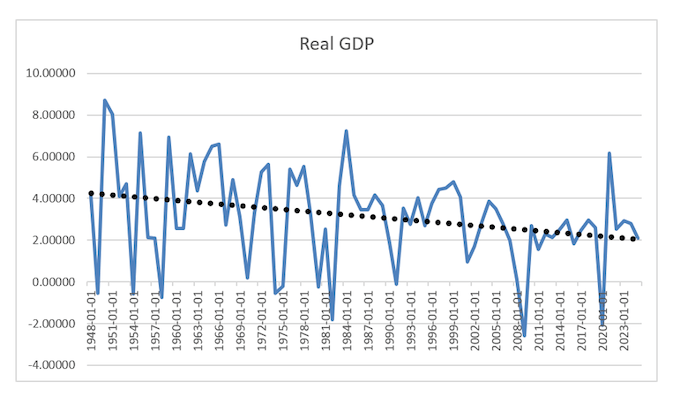
Graph: between 1948 and the end of 2025, the annual rate of Real (inflation-adjusted) GDP growth fell from 4% to 2%. While this might not read as problematic, the US hasn’t prospered outside of finance and tech heavy cities since 1980 or thereabouts (46 years). And financialization means that houses that cost $100,000 twenty years ago cost $400,000 today after ordinary (CPI) inflation has been taken out. This is the flip side of crypto grifts and national stock market obsessions. Source: St. Louis Federal Reserve.
The reason why the US is in this mess is because American leaders misread the unique position that the US was in at the end of WWII as evidence that capitalism actually works. What gave the US its economic prowess was geography, history and luck. By the end of WWII, industrial infrastructure abroad lay in ruins. Because the US was far away, lies between two oceans, and joined the war late, its industrial infrastructure was in better condition after the war ended than before it. To confuse this with grace, intelligence or hard work is a category error.
By the 1980s, the choice for the US was between manufacturing and asset stripping. The leadership at the time (Reagan) chose asset stripping (finance capitalism). With crypto grifts now having reached their natural limit, the US rediscovered war as a business plan— but without the manufacturing base needed to turn military production back into a business. When the political leadership represented the interests of the nation, the New Deal, public schools and a functioning healthcare system were possible. With crypto grifts, only more crypto grifts are possible.
That American capitalism has been redefined as using asymmetrical power to arrange circumstances such that guaranteed gains go to the few while the hollowed-out shell of a looted economy is left for the rest of us, is to empty the term of descriptive value. That this is a result of American imperialism turned inward brings to the fore the source of the social logic of looting. Having been educated in neoclassical economics, almost none of what is today called capitalism fits the theories of academic capitalism. In that version, a large and intrusive state is required to keep capitalism ‘capitalist.’
Monopoly power has long been the economic proxy for the political power of capitalism. In neoclassical theory, a powerful and intrusive state is needed to prevent concentrated wealth from closing the door on new competitors. Neoliberalism thus holds the paradoxical view that 1) economic power doesn’t exist but that 2) the purpose of the state is to support the interests of the economically powerful. The result is that economic ‘freedom’ now means the freedom to loot (e.g. crypto grifts) without legal consequences.
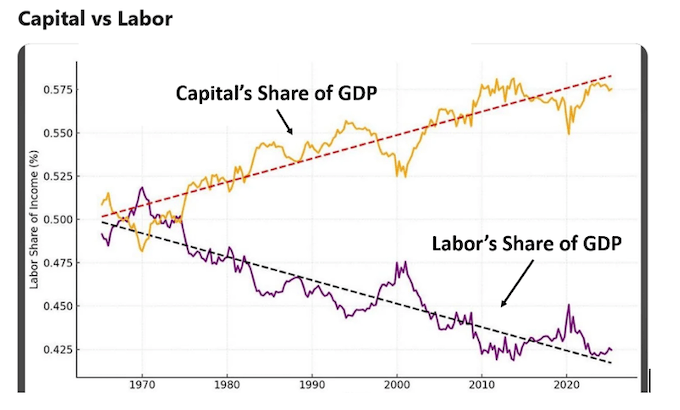
Readers may recall the ‘Great Powers’ framing of the contest for power when the US went to war against Russia in 2022. While the frame makes limited sense with respect to China and Russia, it misses that the US no longer ‘does’ the national interest. The evidence: the few dozen oligarchs whose interests Donald Trump represents are willing to see half of the US population be unemployed through the implementation of AI as long as their fortunes are intact. That they are set up to benefit while the rest of us are set up to lose illustrates the predatory nature of this willingness.
In fact, the oligarchs’ interests are antithetical to those of the US. Trump wants to permanently levitate the stock market because it is the source of the oligarch’s fungible wealth. Bartering a coal mine for goods and services is complicated and cumbersome. But selling shares in the coal mine to the public and then cashing in through stock options is easy, quick and rewarded with tax incentives (discounted capital gains tax rate). The richest 1% owns half of the stock market and the richest 10% owns about 90%. The stock market is central to continuing oligarch control.
To date, the promise of AI has been prospective, that if A, B and C happen, AI will produce a social benefit. Maybe. Maybe not. But the people who haven’t yet demonstrated a social benefit are already billionaires. The heads of AI company Anthropic have $15 billion apiece following a recent fundraising round. Do they have a profitable business? No. AI commenter Ed Zitron argues that Anthropic’s margins scale linearly. In other words, costs rise 1:1 with revenues. Implied is that the current trajectory provides no path to profitability. So, in capitalist terms, why are these people rich?
To be clear, the issue isn’t envy over fat wallets. It is concern over the aggregating impact of the mis-allocation of social resources. If the greed-heads want a sixth yacht, who would care except for the social power that their wealth gives them to force their self-serving decisions onto the rest of us. Automation AI and a wee bit of enterprise AI likely represent our shared future. So do the coming financial crash and its economic fallout from AI funny money (circular) financing. The problem with circular financing is that it sets off a game of musical chairs once one or more or the participating parties begins to take money out.
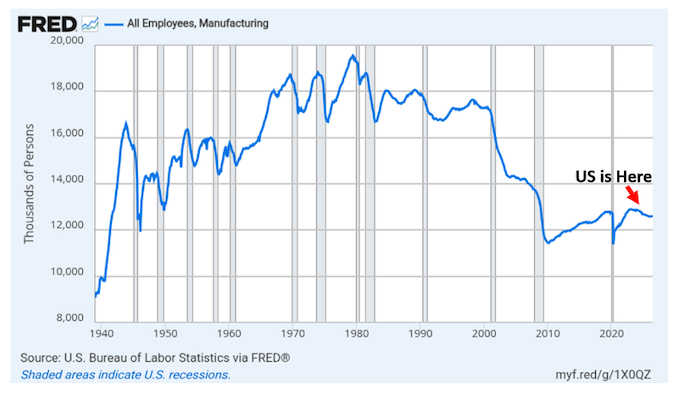
The relevant question is what it is that the American political leadership imagines that the US will do for a living in coming decades. The fantasy that has been sold is that ‘markets’ decide this. In the 1990s, outsourcing was claimed to be the product of nature (wage competition) when it was in fact the result of specific policies promoted by specific interests. American industrialists imagined that they could rid the US of organized labor by ridding it of jobs that pay. Now, with crypto grifts being what it is that Americans ‘do,’ the solution from above is political repression.
This political repression would have different social meaning if the sense was that those imposing it had the people’s interests at heart. But they don’t. We, the people. are viewed as annoying complainers who interfere with stock market gains and persistently rank the people running the place lower than venereal disease and serial killers. And the sense that one of America’s political parties will save us has been replaced with the understanding that nothing in the current political mix is going to do so. We are on our own.